
Detect Bearing
Failures Before They
Stop Production
- SIG · IoT Sensor Stream
- FFT · Envelope · Trend
- Cloud AI · US-based Ops
- Live

Unplanned Downtime
Unexpected bearing failures can interrupt production, disrupt operating schedules, and affect the performance of an entire production line.

Late Defect Detection
Bearing problems may become visible only after vibration, temperature, or mechanical damage has already reached a critical level.

High Maintenance Costs
Emergency repairs, urgent replacement parts, and production losses are significantly more expensive than planned, condition-based maintenance.

Limited Diagnostic Visibility
Manual analysis depends on scarce vibration specialists, while measurements, repair history, and condition data often remain fragmented across disconnected systems.
Collect
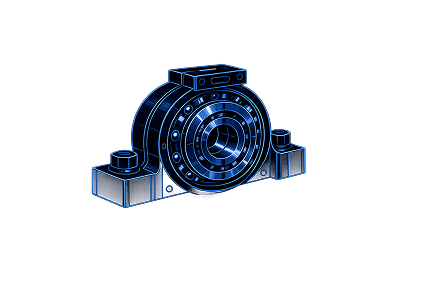
Sensors measure vibration, temperature, and rotational speed directly from the bearing unit.
Transmit
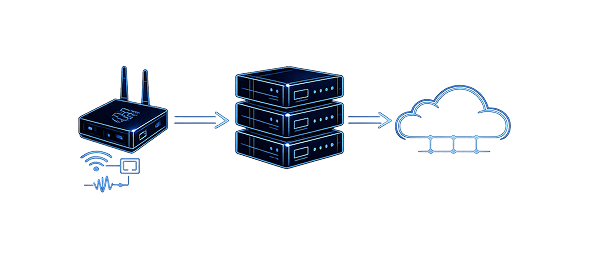
The IoT controller collects the measurements and sends equipment data to the cloud.
Analyze
The system filters noise, extracts features, analyzes trends, and evaluates bearing defect frequencies.

Act
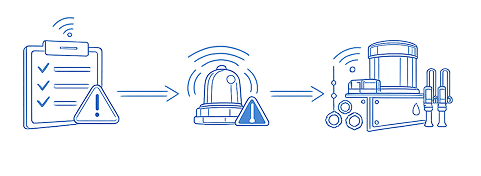
Maintenance teams receive equipment status, detected issues, risk levels, forecasts, and recommended next steps.
- BEARING
- SENSORS
- IOT CONTROLLER
- INTERNET
- CLOUD
- AI ANALYSIS
- DASHBOARD

Vibration
- RMS velocity
- RMS acceleration
- Acceleration peaks
- FFT spectrum
- Envelope analysis
- Crest factor
- BPFO, BPFI, BSF, and FTF indicators

Temperature
- Current temperature
- Historical trend
- Rate of temperature increase
- Abnormal heating detection

Rotational Speed
- Actual RPM
- Speed fluctuations
- Operating instability
- Relationship between RPM and vibration behavior
AI Diagnostics
Outer and inner ring defects
Rolling element defects
Misalignment, shaft offset, and imbalance
Potential lubrication issues

Prediction
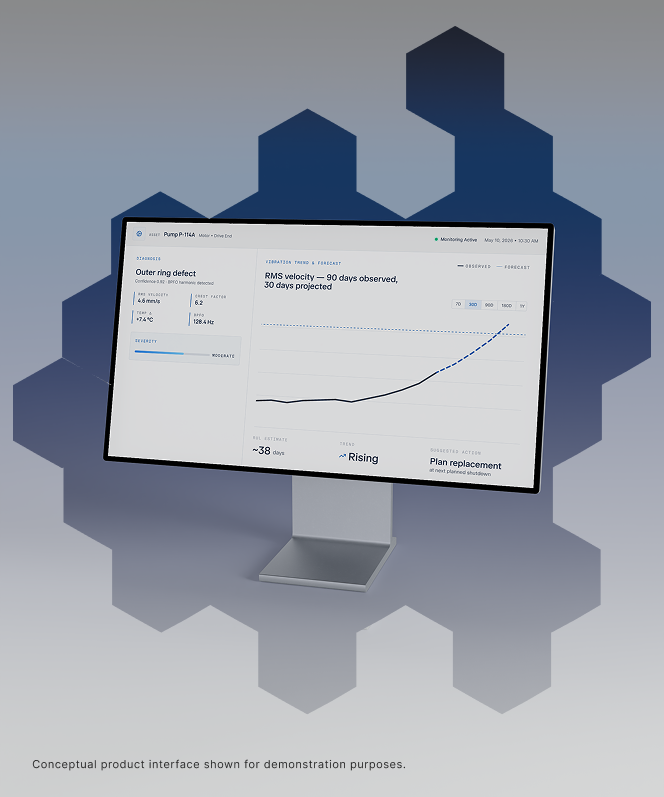
Tracks changes in vibration indicators over time and estimates how vibration levels may develop based on observed trends.
Remaining Useful LifeEstimates the bearing’s remaining operating time under current condition trends.
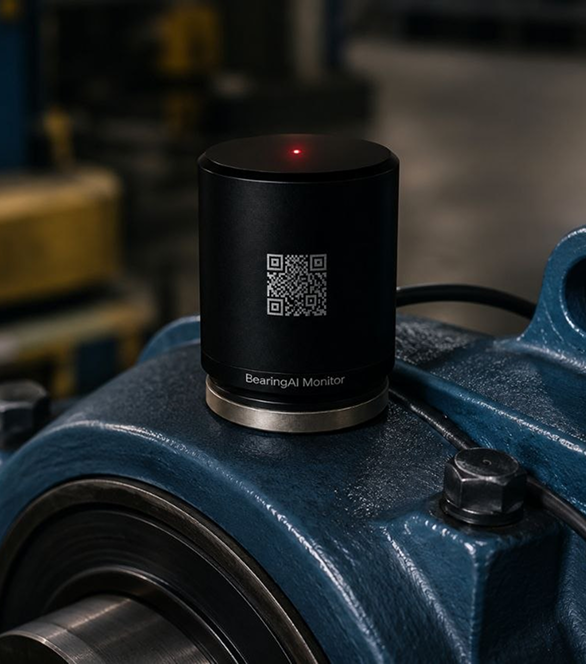
The BearingAI Monitor wireless sensor continuously measures vibration and temperature on bearing units and other rotating industrial equipment.
Mounted directly to the equipment housing with a neodymium magnet, it provides stable measurement without drilling, wiring, or permanent equipment modification. Collected data is transmitted via LoRaWAN to the cloud for trend analysis and early detection of developing equipment abnormalities.
Vibration Monitoring
Temperature Monitoring

Fast Magnetic Installation

Wireless & Battery Powered

10–1000 Hz
Vibration frequency range

0.1–100 mm/s RMS
Vibration velocity range

-40 to +85 C
Temperature range

LoRaWAN
Wireless data transmission
-
 Email
evchumak.ec@gmail.com
Email
evchumak.ec@gmail.com
-
 Location
USA
Location
USA